If you take away one rule from the science of multimedia learning, make it this one: when a visual needs words, say them out loud — don’t print them on the screen next to the picture.
The bottleneck
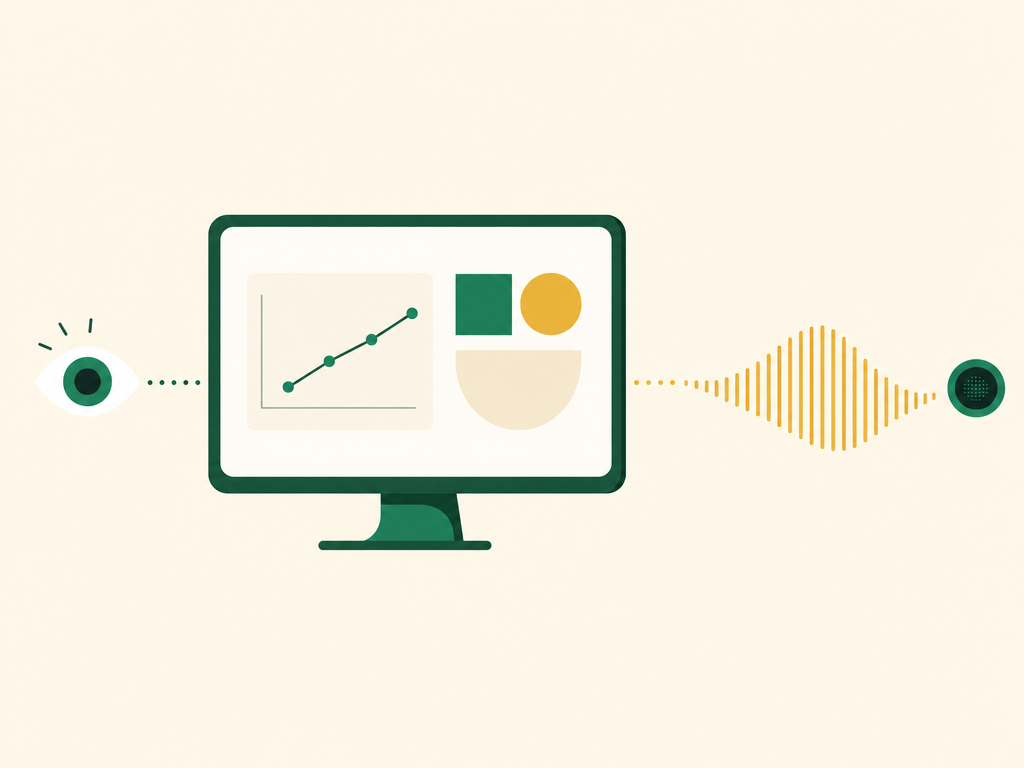
Working memory has separate, limited channels for what you see and what you hear. On-screen text is processed through the visual channel — the same channel a diagram needs. Put both on screen and the learner’s eyes ping-pong between reading the words and studying the graphic. Neither gets full attention. Researchers call this the split-attention effect, and it’s a silent drain on the exact capacity you need to actually understand something.
The fix
Narration moves the words to the auditory channel. Now the eyes are free to follow the visual while the ears take in the explanation. The two streams arrive in parallel and the mind integrates them — instead of forcing one channel to do two jobs at once. In Mayer’s experiments, simply switching identical words from on-screen text to narration improved performance on understanding-and-transfer tasks. Same content, better learning, purely from how it was delivered.
The trap: don’t do both
The instinct is to narrate AND show the text “to be safe.” That backfires. The redundancy principle shows that duplicating narration with identical on-screen text reintroduces the very visual-channel competition you just removed — and learning drops back down. More inputs isn’t the goal; the right pairing is.
What this looks like at Scolavo
Our lessons are narrated films: a clear voice carries the explanation while the screen carries the visual — the illustration, the diagram, the worked example. We deliberately avoid pasting the script onto the slide. The result is a lesson that respects the shape of attention instead of fighting it, and an explanation that lands the first time.