Here is one of the most useful and least intuitive facts in all of learning science: the act of trying to remember something is not just a way to measure learning — it is one of the strongest ways to cause it. Being asked a question changes your memory more than reading the answer again does. Testing isn't the thing you do after learning. Done right, it is the learning.
The study that named it
In 2006, Henry Roediger and Jeffrey Karpicke ran an experiment that has since been replicated many times. Students read short prose passages, then either re-read the passage or took a free-recall test on it — writing down everything they could remember with the passage out of sight. On a quiz five minutes later, the re-readers actually did slightly better. Reasonable enough; they'd just looked at the material again.
Then the researchers waited a week. On a test one week later, the pattern flipped hard. The students who had been tested remembered about 61% of the material; the students who had only re-read remembered about 40%. The group that did the harder, less pleasant thing — pulling the answer out of their own heads — held onto far more of it. That gap is the testing effect, and it grows wider the longer you wait before the final test. Which, in real life, is always.
Why pulling beats pushing
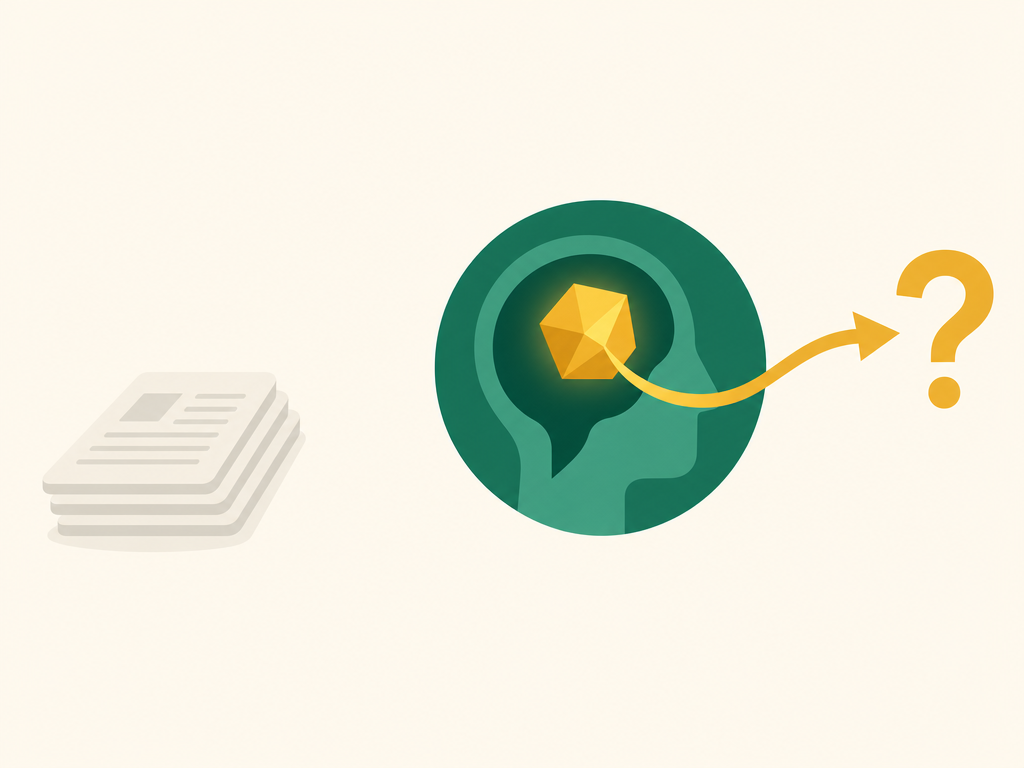
When you re-read or re-watch, information flows in. It feels smooth, and that smoothness is exactly the problem: recognizing words on a page is easy, and your brain mistakes 'this looks familiar' for 'I know this.' Retrieval works the other way around. You have to reconstruct the idea from the inside, with the source hidden. That effortful reconstruction strengthens the memory trace and builds new routes back to it, so the idea is easier to find next time. Psychologists call retrieval a 'memory modifier,' not just a readout — every time you successfully pull something up, you make the next pull more likely.
Desirable difficulties: the feeling that lies to you
Robert Bjork coined the phrase 'desirable difficulties' for exactly this kind of thing: conditions that make learning feel slower and harder in the moment but produce more durable, flexible knowledge in the long run. Retrieval practice is the headline example. Spacing your practice out and mixing topics together are two others.
The catch is that the difficulty feels like failure while you're in it. Re-reading produces a warm glow of fluency; being quizzed produces the slight discomfort of effort and the occasional wrong answer. Study after study finds that learners rate re-reading as more effective and prefer it — even in experiments where they personally learned more from being tested. Your sense of how well a session is going is, frankly, an unreliable narrator. The strategy that feels best is usually not the one that works best.
Even getting it wrong helps
One of the most surprising results in this literature: attempting to answer a question before you know the answer improves learning, even when your guess is wrong — provided you get corrective feedback right after. The act of searching your memory and committing to an answer primes you to absorb the correct one. So a quick-check that you fail isn't wasted; it's a setup. This is also why a low-stakes question beats a high-stakes one. The goal is to make retrieval frequent and consequence-free, so you'll actually attempt it instead of avoiding it.
What the research says to actually do
- Close the book and ask yourself the question before you check the answer — recognition is not recall.
- Test early and often in small doses, rather than cramming one big review at the end.
- Space the checks out over time; revisiting after a delay is harder and therefore stronger.
- Always pair an attempt with immediate feedback, so a wrong answer becomes a correction, not a stuck mistake.
- Treat the discomfort as the signal that it's working, not the signal to switch back to re-reading.
How Scolavo is built around this
This is the reason a Scolavo lesson is not just something you watch. After the cinematic film makes an idea land, the interactive 'Learn' deck interrupts the smooth flow with quick-checks — small questions placed right at the moment a concept has been introduced. They are deliberately low-stakes: the point isn't to grade you, it's to make you pull the idea out of your own head while it's fresh, and to give you the answer immediately whether you got it right or not. That single act of retrieval does more for retention than replaying the clip would.
Then the mastery quiz at the end of a class does the heavier version of the same job — spaced a little later, pulling together everything from the lesson, asking you to reconstruct rather than recognize. It isn't a gate you pass through on the way out; it's where a lot of the actual learning happens. And because your results save to your account, Scolavo can bring questions back after a delay, turning a one-time quiz into spaced retrieval over weeks — which is precisely the condition under which the testing effect is largest.
The honest summary
Re-watching a great lesson feels wonderful and teaches you less than you think. A short, slightly uncomfortable question teaches you more than it feels like it should. We built the quick-checks and quizzes to lean into that gap on purpose — not to test whether you learned, but to be part of how you do. So when a question pops up mid-lesson, resist the urge to scroll back for the answer. Take the guess. The struggle is the point.
If you want to cite it
The foundational paper is Roediger & Karpicke, 'Test-Enhanced Learning' (Psychological Science, 2006). For desirable difficulties, see Bjork & Bjork's work on memory and learning; for a readable popular treatment of the whole picture, the book 'Make It Stick' by Brown, Roediger, and McDaniel collects the evidence and the practical takeaways.