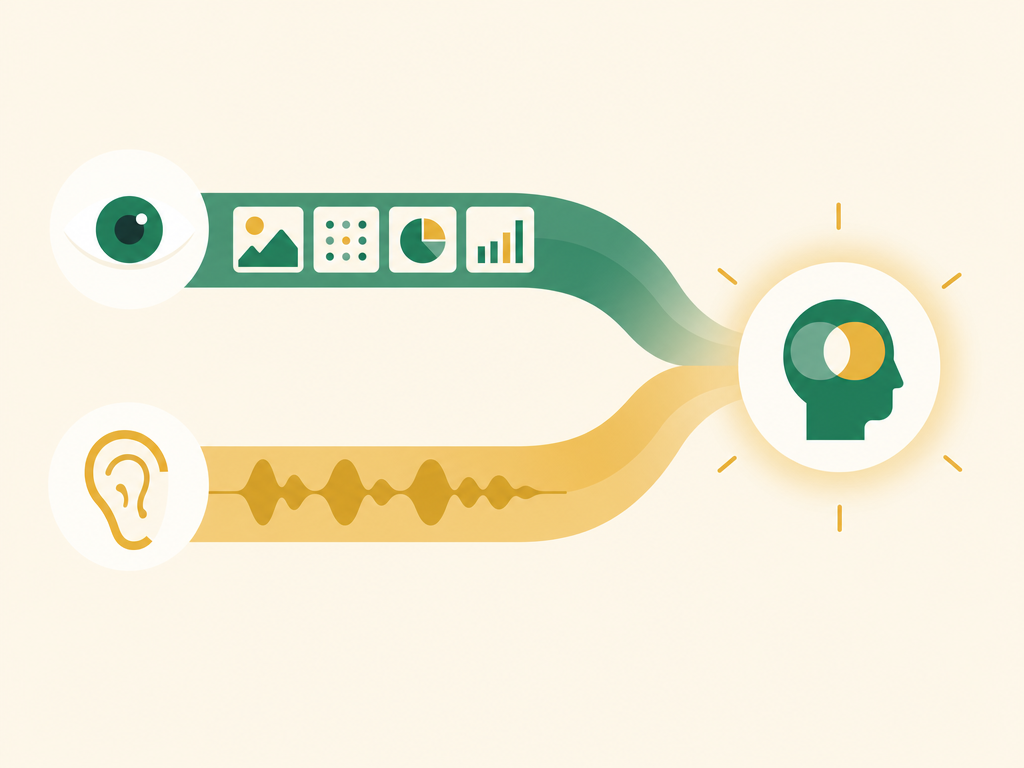
The short version: combining visuals with narration takes advantage of how working memory is actually structured, and plain text doesn’t. This isn’t a style preference — it’s one of the most replicated findings in educational psychology, converging from two frameworks built over forty years.
Two channels, not one
Dual-coding theory, developed by Allan Paivio, holds that the mind processes verbal and visual information through two partially separate channels. Information encoded in both channels gets two routes to retrieval rather than one. That is why a labeled diagram tends to stick better than the same content described in a paragraph: you’ve laid down a picture and a verbal trace, and either one can later pull the idea back up.
The framework that matters most: Mayer’s CTML
Richard Mayer’s Cognitive Theory of Multimedia Learning builds directly on dual coding and is the most relevant body of work to how a lesson should be designed. It rests on three premises:
- There are separate channels for auditory/verbal input and visual/pictorial input.
- Each channel has a sharply limited capacity — you can only hold a few elements at once.
- Meaningful learning requires active processing within those limits: selecting, organizing, and integrating.
From those premises, two decades of controlled experiments produced a set of design principles. Two of them speak exactly to “visuals + narration versus plain text.”
The multimedia principle
People learn more deeply from words and pictures together than from words alone. Across many studies this produced large effect sizes — and crucially, on transfer tests (applying knowledge to a new problem), not just on recognizing what they’d seen. The gain shows up where it counts: understanding, not memorization.
The modality principle — the case for narration
This is the key one. When you pair a visual with spoken words rather than on-screen text, learning improves. The reason is mechanical: on-screen text and a graphic both compete for the same visual channel, so the eyes have to ping-pong between them. That is the split-attention effect, and it quietly taxes the very capacity you need for understanding.
Narration offloads the words to the auditory channel, leaving the visual channel free to process the graphic. Instead of two streams fighting over one bottleneck, they arrive in parallel and get integrated. This is the single biggest reason Scolavo lessons are narrated rather than captioned walls of text.
The corollary: more inputs is not the goal
The redundancy principle is the natural follow-on. Adding on-screen text that duplicates the narration usually hurts rather than helps, because it reintroduces the visual-channel competition you just eliminated. So the win isn’t “pile on more.” It’s the specific pairing of a relevant visual with audio that distributes the load across both channels.
Why visuals earn their place over prose
- They make spatial, structural, and relational information explicit — a process flow, an anatomy, a system — that prose forces the reader to reconstruct mentally.
- Narration carries pacing and emphasis: tone and stress that flat text simply can’t encode.
- Together they give the learner two complementary models of the same idea, which is what robust understanding is made of.
The honest caveats
Good research comes with boundary conditions, and these matter:
- Expertise reversal effect: these benefits are strongest for novices and tend to shrink — or even reverse — for experts, who can be slowed down by support they no longer need.
- Coherence principle: the effect depends on the visuals being relevant. Decorative images and incidental detail distract rather than help.
This is exactly why Scolavo builds the same subject at different levels — an Explorer course for a curious 9-year-old is not a slower Expert course; it is designed for a novice, with visuals matched to that learner. The science says the design has to fit the audience, not just the topic.
How Scolavo is built around this
Every lesson is a short narrated film paired with relevant illustration — visual and audio in parallel, no redundant on-screen text — and then a click-through interactive version that forces active processing rather than passive watching. The pairing isn’t an aesthetic choice. It’s the architecture of working memory, applied.
If you want to cite it
The canonical sources are Mayer’s Multimedia Learning (Cambridge University Press) and Paivio’s Mental Representations: A Dual Coding Approach (1986). The Cambridge Handbook of Multimedia Learning, edited by Mayer, is the standard volume collecting the meta-analytic evidence and the individual principles.